

James Lyons-Weiler and Paul Thomas published a “study” in November 2020 that was retracted a few months later. It’s worth noting that this was a pay-to-publish piece, which is often a red flag and should be a warning to use careful scrutiny. Further, the journal is published by MDPI, which is known to have variable quality and occasional acceptance of weak or flawed papers.
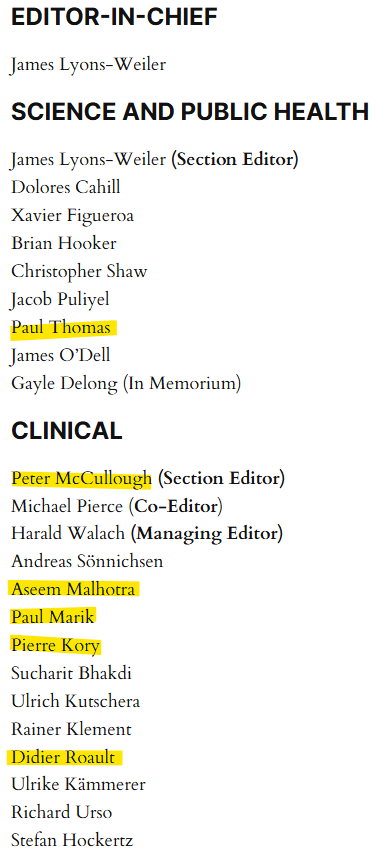
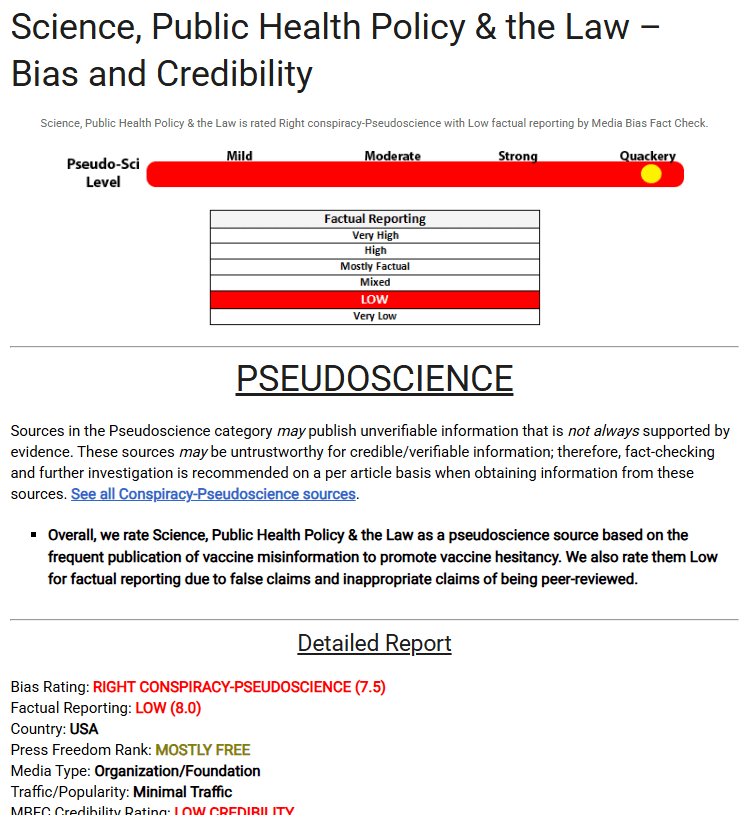
First, Lyons-Weiler is a known antivax activist. He’s behind the fake journal Science, Public Health Policy and the Law. The editorial board (incomplete list below, left) is a who’s who of notorious misinformation spreaders and Media Bias/Fact Check lists them as “Quackery” (right). Also note that Thomas is a board member. One very simple way of determining if a paper is sketchy is to find if any members of this board are listed as coauthors or if any of them push it on social media.
Methodological Failures of the MDPI Study
- It did not control for many major confounding variables which means that vaccinated and unvaccinated groups are very different.
- Vaccine hesitancy by parents
- Access to care
- Socioeconomic status
- The sample is not representative of the population in that it’s from Thomas’ clinic which heavily skews toward antivax parents.
- Use of invalid statistical methods for the data presented which the journal called “several methodological issues” in the retraction notice.
- The use of billed office visits as a proxy for disease occurrence is a mistake that even a first-year epidemiology student would not likely make (with perhaps the exception of someone like Nicholas Hulscher). The difference is behavioral, not biological. If unvaccinated children simply don’t show up, their “healthier” appearance is an artifact of missing data, not lower disease burden
- Unvaccinated families avoid medical care.
- Vaccinated families are more likely to seek care more frequently.
- The authors didn’t disclose their ideological and financial conflicts of interest.
- The retraction notice “confirmed that the conclusions were not supported by strong scientific data.”
Undisclosed Conflicts and Antivax Networks
The Acknowledgements section is telling.

Hiding the names of others involved in the study is gross scientific negligence in that one cannot assess their ideological financial conflicts of interest. This is both unethical and lacks research transparency.
Oregon Medical Board: Documented Harm
The Oregon Medical Board ordered and emergency suspension of Thomas’ license on December 4, 2020. The antivax community claims it was due to his paper, but that is not true. It states that he “has breached the standard of care and has placed the health and safety of many of his patients at serious risk of harm.” They add “Licensee has published an alternative vaccination schedule that decreases the frequency of many recommended vaccines and omits others, including rotavirus. Licensee promotes his unique, “Dr. Paul approved” schedule as providing superior results to any other option, namely improved health on many measures, and fraudulently asserts that following his vaccine schedule will prevent or decrease the incidence of autism and other developmental disorders.” This is interesting because it doesn’t look as if he ever did any research on his “Dr. Paul approved” schedule, although it’s pretty apparent it would be massively flawed anyway.
It also sounds like his interpersonal skills are lacking. “A patient’s mother sought subsequent treatment by Provider X after having been “reduced to tears” by Licensee’s “bullying” her into his personal vaccine schedule against her express wishes for full vaccination for her child…the Licensee questioned why she wanted Patient A to get the polio vaccine and asked whether they were traveling to Africa. During the appointment, Licensee continually connected vaccines (not specific) with autism. Licensee asked her how awful she would feel if Patient A got autism and she could have prevented it.”
He Caused Patient Suffering and Harm
Patient B, an 11-year-old male, was immunized on a delayed schedule according to Licensee’s recommendation and practice agreements. Patient B was subsequently diagnosed with pertussis on September 24, 2018, requiring office visits and antibiotics.
Patient C is a now 7-year-old male. He was admitted to Randall Children’s Hospital in August 2013 at approximately 10 weeks of life with fever and a diagnosis of Kawasaki’s disease. Licensee saw Patient C in clinic for three days in clinic with fever. Though Dr. Thomas reevaluated Patient C daily and sent repeated labs, he made a clinical decision to treat a febrile child a less than 3 months old with intramuscular ceftriaxone on the basis of a “bagged” and not catharized urine sample and in the absence of blood cultures. Any child of this age is at higher risk for serious bacterial infection (late onset group B strep, pneumococcal bacteremia, urinary tract infection, pneumonia, meningitis) as well as inflammatory illnesses such as Kawasaki’s disease. Licensee breached the standard of care by failing to refer Patient C to the Emergency Room or hospital for definitive lab testing.
Patient D, a now 9-year-old male, was completely non-immunized. Patient D sustained a large, deep scalp laceration at home in a farm setting on August 8, 2017, and was treated with colloidal silver and with his parents suturing the wound independently. Patient D subsequently developed acute tetanus requiring intubation, tracheotomy, feeding tube placement and an almost two- month ICU stay at Doernbecher Children’s Hospital. Patient D was then transferred to Legacy Rehabilitation. Licensee saw Patient D for follow-up in clinic on November 17, 2017. Licensee’s notes documented a referral to a homeopath, recommendation of fish oil supplements, and “phosphatidyl seine.” He did not document an informed consent discussion about the risk/benefit of immunization for a child who had just sustained and still had sequelae of, and remained vulnerable despite prior infection, to tetanus, a life-threatening and disabling disease that is preventable by proper vaccination. Licensee’s care placed Patient D at serious risk of harm and constitutes gross negligence
Those are just the first ones. There are others listed in the suspension notice. The claim that his license suspension had ANYTHING to do with the retracted paper is just wrong. Taken together, these cases show a consistent pattern: Thomas’ vaccine ideology repeatedly overrode basic pediatric safety norms.
PHOI: Big Promises, No Transparency. Possible Grift?
On his CV, he lists himself as the founder of the Pediatrics Health Outcomes Initiative (PHOI). He claimed on Facebook it would be “the Framingham study of our time,” which is an amazing amount of hubris. The Framingham study had been ongoing since 1948 and is highly respected.

The earliest information on PHOI I could find was their first Facebook post. Of course, RFK Jr was tied into it. Birds of a feather flock together.

The big question then is where did the money go that they raised?

The link to the PHOI website on the PHOI Facebook page is dead and there hasn’t been a post on their Facebook page since February 9, 2021. That seems kind of suspicious since that was just after he was getting in trouble with the Oregon Medical Board, Perhaps he didn’t want them to discover fraud, although this is obviously just an inference based on circumstantial evidence. He’s been keeping the board kind of busy and finally surrendered his license and will never practice in Oregon again.

Addendum
He describes himself as “retired.” That’s quite the spin.


