What do all these cities have in common? They all had 2010 populations that were within 10% of 100,000 people. We crossed that total death threshold in the US today.
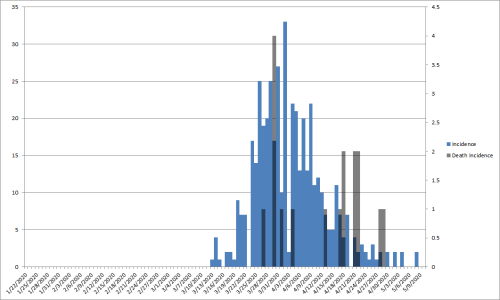
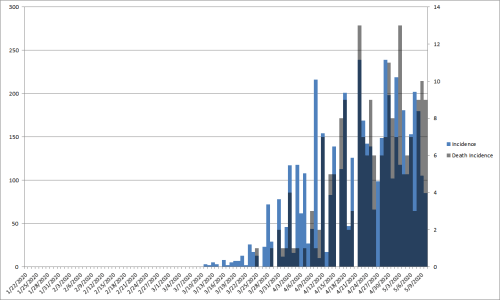
It might be worth looking at data from states that have ended stay at home orders to see if it has any impact on new case trends. Only three states have a sufficient number of cases and population at this point for review. My commentary for each is in red text. The rest of narrative about each state is from CNN and was updated on May 20th. The three week post opening point is the divider between the blue and gray portions of the graph. Trend lines are the dotted lines within each.
Colorado
Colorado also has some interesting results from PCR versus serology testing. Clearly the testing impacts some of the numbers of cases. More interesting is that such a high percentage of serology tests are negative. I wonder if people think that they had been infected really weren’t. I’ve heard a lot of people claiming that they “probably” had this back in January or late last year. I’ve told them it’s just about impossible if they were in the US during that time frame.
The state’s “safer-at-home” order took effect April 27 and is in effect until May 27.
Retail businesses can reopen with curbside delivery and elective medical procedures can resume. Businesses such as personal training and dog grooming can reopen with social distancing.
Retail businesses began to reopen May 1, while people were permitted to return to non-essential office work May 4.
On May 11, Gov. Jared Polis said state park campsites would be available for rental beginning May 12.
A decision on restaurant reopenings will happen May 25, the governor said.
Georgia
Georgia has a 14 day lag in collecting data. However, in their trend forecast, they are expecting an even steeper rise in the second graph.
Gyms, fitness centers, bowling alleys, body art studios, barbers, hair and nail salons, estheticians and massage therapists were able to reopen April 24, with certain rules. Theaters and restaurants were allowed to reopen April 27, also with caveats.
The caveats include social distancing and screening employees for illness.
Bars, nightclubs and music venues will remain closed, for now.
A shelter-in-place order for “medically fragile and elderly Georgians” is in place through June 12.
The shelter-in-place order for other Georgians ended April 30.
Oklahoma
Oklahoma has something very interesting. When looking at the data for the whole state, it looks like easing up on the stay at home orders. However, when limiting it to the data set of the metropolitan counties in the Oklahoma City and Tulsa areas, a different pattern emerges. There are 14 of the 77 counties in the state in this view. This is pretty good anecdotal evidence that population density makes a big difference.
Also, I realize that the graphs are a bit different and the midpoint is two days later in the bottom one. It’s a function of pulling state data in batches to match the change date and I didn’t think of this view until I had changed some of the formulas in my data table. I think it’s safe to assume that the trend lines are still representative of the data.
Gov. Kevin Stitt allowed some businesses to reopen beginning April 24.
Among them are personal care businesses, restaurants, dining rooms, movie theaters, sporting venues and gyms if they maintain “strict social distancing and sanitation protocols.”
Bars, however, will still be closed.
Conclusion
Science is funny about conclusions. I think from these examples, there is a common trend, however, like many analyses, further data is needed. That will come when more states have 4-5 weeks of data after ending stay at home orders.
In the US, we have a national holiday on Monday called Memorial Day that honors those who died serving in the US military. For many Americans, they view it as a three-day weekend and is often when recreational activities begin, pools open, people go camping, and many other social activities.
My fear this year is because of all of the mixed messages about COVID-19 at all levels of government, people are frustrated and confused, and rightly so. The need to continue social distancing measures seems to have gotten lost in the noise.
For most Americans, I think it would be very unwise to spend time this weekend with friends or family members outside of your immediate household. We are still benefiting from the stricter measures that had been put in place by various states, which has probably developed a sense of complacency that this is all over. Unfortunately, making that assumption could be very perilous.
Something happened this week that might help impress how serious this situation still is in spite of being in analogous eye of the storm.
I urge people only be around those in their immediate household and avoid any areas where there would normally large crowds of the public. This weekend promises to be a massive mixing event for the virus in the US population.
Yes, I may be wrong. You may lose your plans for one holiday weekend if I’m wrong. However, if I’m right, you or your loved ones could lose dozens of holiday weekends in the future. The cost/benefit analysis on this seems pretty clear to me.
Those who have experienced hurricanes know just how deadly they can be during normal times. The hurricane season in the Atlantic Basin officially begins on June 1, but I thought it important to get people thinking in advance and making plans . It will be considerably more challenging this year as this has to be done while also being concerned about social distancing and possible travel restriction due to the coronavirus while it continues its spread throughout the world.
Those who are in areas that are under threats of these kinds of storms should be planning ahead because of the challenges that lie ahead this year if a hurricane hits.
First, I would argue that it would be wise to consider how evacuation will occur. When doing emergency planning, it’s always best to plan for the worst and hope for the best. It is possible that there might be restrictions on travel to other states. I have been hearing anecdotally of discussions being taken in some areas around the US related to various rules about what businesses can be open and which cannot simply based on which side of a state line the business is on. Obviously during an emergency, travel restrictions would be altered, but that may impact those who decide to leave before an official evacuation order.
Another important consideration with travel will be doing so safely. Think about how gas pumps may be contaminated by the person that used it before you. I keep some cheap sandwich bags in my glove compartment to use as a barrier between the gas pump and myself.
Also consider indoor restrooms. I would be a bit reluctant to use one in a restaurant, gas station, or public rest area, both because of the volume of people that would pass through, but also because of the possibility of virus remaining in the air if someone had just been there who was sick who may or may not be symptomatic. While most people don’t like them, I think that it would be worth considering finding portable toilets at a local park. They usually have hand sanitizer in them but also likely have had a lot less people going through them. Of course, there are no guarantees though about who may have last used either type of facility and how long ago they had been there.
It would also be worth thinking through an evacuation destination. I would be reluctant to be in a hotel with a bunch of others who have evacuated. That simply seems risky. It might be worth finding a friend or family member who would be able to take you and your family in. However, to keep them safe, it would be best to do self quarantine in their home as well, which could be very tricky to do. There are no simple answers and it is part of the reason I’m suggesting thinking ahead.
What seems to be the worst case scenario though from a disease spread standpoint would be to wind up in a public shelter. Outbreaks have been associated with hurricane shelters, including medical shelters where the medical team was impacted. This would be the last place I would want to be while COVID-19 is an issue, but if there is no other options, it’s safer than being exposed to a storm. That’s why I’m suggesting that people who live in areas that have tornadoes, hurricanes, major tropical storm risks, or tropical cyclones start their planning now.
It’s very tricky to work on this because of so many variables coming into play, such as what percentage of customers are allowed in a business, what types of businesses are allowed to be open, what kind of public response will occur, and compliance with various measures. There are also fixed variables that play a role such as population density to consider as well. As such, I’m only going to do some very rough estimates by state. Some states haven’t put any kind of stay at home restrictions/advice in place.
Cases – This is roughly the date at which I expect some of the first cases to start showing up in the data related to reopening or easing up on business restrictions. However, it may not be immediately identifiable because of both variability in case identification as well as increased testing. It should be noted that I primarily tried to use stay at home orders for this date, but in some cases, reopening business dates needed to be used. This date may also be based on a projected reopening date, which is also subject to change since these can still change.
Deaths – This date reflects roughly when deaths are going to start emerging from the new cases.
Impact – This is the date by which trends in the data should be clear if things were done too quickly.
There are three places with exceptions. Illinois and DC still have restrictions in place, South Dakota has not had any, although tribal nations within the state have had different rules in place by their tribal governments.
Obviously its too soon to make sense of any data emerging by state right now in comparison to more restrictive orders. However, I thought it might be useful to get some dates set to analyze whether or not my argument for lag times was justified. Honestly, I would really like to be proven wrong and see things considerably improve.
By my earlier argument, we should see improvement in the US totals starting to emerge between April 12th and May 3rd. Of course, these have an additive impact the longer they are in place. Without these measures, the epidemic curve would have continued upward and been too big for the image below by late April.
Now, however, many locations are going to go right back to square one, but realistically, it will be further back than square one, because now there will be many more cases spreading to the population and the healthcare problems will be more challenging as there are less supplies, medication, and staff available.
I’ve been warning since April that things were going to take a turn for the worse in June. We have excelled at shooting ourselves in the foot.
A number of people think that we should simply let COVID-19 take its course without intervention. Aside from the fact that it would completely destroy our healthcare system, just look at the numbers of what that would mean.
Let this sink in. It means we would need to sacrifice 2,986,620 Americans to reach herd immunity (95% central credible interval 1,378,440 to 4,824,540).
I really hope people don’t realize what they are saying when they say the disease should just take its natural course. I don’t even know what to think of them if they do, but to put it in perspective, about 6 million Jews were killed during the Holocaust. Are people really saying that they think that an event half that scale is acceptable? I simply cannot wrap my head around that.
I spent some time trying to figure out how to compare states executive orders trying to find some patterns for comparison but that turned into a futile exercise. Instead, I’ll add the summaries of each as given by CNN on May 7th below each graph.
Please note that these graphs are a little bit different than normal. The scale on the left is new cases of illness, on the right is new deaths. The light blue is cases, and the semi-transparent gray is deaths so both graphs can be seen and are very dark on overlap areas. Also note that the scales are different between states. The reason for this is to give a visual idea if any state is really flattening the curve or not.
I leave it to you to determine if the measures being taken in your state make senses against the data. If you don’t like the course your state is taking, you can find the contact information for your governor easily enough.
Alabama
When the state’s stay-at-home order expired April 30, it issued a replacement order that encouraged people to stay home and continued to ban non-work gatherings of 10 people or more. It also allowed retailers and beaches to reopen, with restrictions.
Starting May 11, new rules will be in place, through at least May 22:
— Non-work gatherings of any size will be allowed, as long as people maintain 6 feet of distancing, Gov Kay Ivey said. That includes houses of worship.
— Gyms, athletic facilities, barber shops, hair salons, nail salons can reopen, with certain rules.
— Restaurants, bars and breweries may allow on-property consumption of food and drink, with certain rules.
— Still closed are certain entertainment venues like theaters, casinos, bowling alleys and night clubs.
Alaska
Gov. Mike Dunleavy allowed personal services businesses and restaurants in most parts of Alaska to reopen April 24, but with restrictions.
Hair salons can only admit customers by reservation. Restaurants will have to keep distances between tables and can’t exceed 25% of their normal capacity.
The city of Anchorage delayed the new rules until April 27.
The second phase will begin, Friday, May 8. Dine-in restaurants will be capped at 50% of their usual capacity. Bars will be able to reopen for the first time, but only at 25% of capacity. The same limit applies to indoor fitness classes.
Religious gatherings will be allowed, but with a limit of 50 people. The state rules say anyone who sings should be 10 feet away from the nearest person.
Arizona
Arizona will allow retail stores to do in-person business again Friday, May 8 with strict physical distancing, Gov. Doug Ducey said May 4.
Ducey said new coronavirus cases are declining “Arizona is heading in the right direction,” said Ducey. Barbershops and salons are included in the May 8 reopening order, although all businesses are required to maintain social distancing.
On Monday, May 11, Ducey says Arizona restaurants will be able to offer dine-in services again. The governor says the state is working with the industry to come up with specific distancing rules for restaurants later in the week.
Ducey on April 29 extended the state’s stay-at-home order until May 15 with modifications. Under the new order, elective surgeries coud begin May 1. The governor said then he hopes to be able to reopen restaurants May 12.
Navajo Nation extended the closure of its government until May 17.
Arkansas
Gov. Asa Hutchinson said April 30 that gyms, fitness centers, and indoor athletic facilities can resume operations beginning May 4. Barbershops and hair salons can open Wednesday, May 6.
The governor has announced his state will allow restaurants to open for limited dine-in service May 11. Restaurants will be able to operate at a third of their normal capacity and they must limit groups to no larger than 10 people.
Hutchinson added that if the state continues to see a downward trend of coronavirus cases, it will move into a second phase by allowing restaurants to increase to 67% of capacity.
Hutchinson on May 4 said the state encourages places of worship to use online platforms for services, but can also have in-person events. The guidelines include: signs advising anyone who has been sick they shouldn’t enter, 6 feet of social distancing inside except for family groups, and face coverings for everyone older than 10.
California
Gov. Gavin Newsom issued a stay-at-home order on March 19 that has no set end date.
The state will begin allowing scheduled surgeries. Newsom emphasized the surgeries being phased back in are important medical procedures like heart surgery or removing cancerous tumors that should not be neglected. Elective procedures like cosmetic surgery are still not a priority.
However, California is pulling back on issuing permits for events and activities, including protests, at all state facilities, according to the California Highway Patrol.
Newsom said May 1 that he is “days, not weeks” away from beginning to lift some restrictions in the state’s stay-at-home order. A day earlier, he ordered beaches in Orange County closed after beachgoers crowded the beaches during a hot weekend. His order was followed by a large protest in Huntington Beach. On May 4, the governor said beaches in the cities of Laguna Beach and San Clemente in Orange County can reopen on a limited basis. Newport Beach opened May 6 for some activities.
Also May 4 the state announced some retailers — clothing stores, florists, and bookshops — will be allowed to reopen with curbside pickup and physical distancing. Associated manufacturing and supply chain for those retail businesses will also be able to get back to work.
Colorado
The state’s “safer at home” order took effect April 27 and is in effect until May 27.
Retail businesses can reopen with curbside delivery and elective medical procedures can resume. Businesses such as personal training and dog grooming can reopen with social distancing.
Retail businesses began to reopen May 1, while people will be permitted to return to non-essential office work May 4. The state also joined with Nevada and three West Coast states to coordinate their Covid-19 reopening plans.
Polis warned people not to think the coronavirus emergency is over, however. “It’s not going to be life as normal. We’re in this for the long haul, but it’s sustainable for the medium term,” Polis said in a press conference the day the order was lifted.
Denver Mayor Michael Hancock extended the city’s stay-at-home order until at least May 8.
Connecticut
Connecticut Gov. Ned Lamont extended the mandatory shutdown in the state until May 20.
But, Lamont said more testing is needed so the state can reopen by that date. He praised the federal government for loosening regulations on testing ingredients so they can expand testing more quickly.
Beth Bye, the state’s early childhood education commissioner, announced May 5 that Connecticut summer camps can open on June 29, but must adhere to guidelines, including limiting groups to 10 children.
Lamont and the state’s top education officials said they hope to reopen for summer schools in July.
The state has also ordered tens of thousands of “fever-meters” thermometers, which Lamont says will be “incredibly helpful” when folks go back to work at big manufacturers where temperatures can be taken before entering the buildings.
Connecticut has joined a coalition with the Northeastern states of New Jersey, New York, Pennsylvania, Delaware, Rhode Island and Massachusetts to coordinate the reopening of the economy, according to a news release from New York Gov. Andrew Cuomo’s office.
On April 30, Lamont outlined the industries that officials in the state are looking at for re-opening on May 20.
So far the list includes outdoor-only restaurants (no bar areas), outdoor zoos and outdoor museums, university research programs, hair and nail services, remaining retail that’s currently been deemed as non-essential, some offices — although individuals should be encouraged to work from home where possible.
Delaware
Gov. John Carney issued a statewide stay-at-home order that will remain until May 15 or until the “public health threat is eliminated.” Carney said the state will consider reopening its economy only after seeing 28 days of declining Covid-19 cases.
“By the end of the week, I think we’ll have a comprehensive testing plan that will require more than double the number of tests that we have now,” Carney said on April 29.
Delaware has joined a coalition with the Northeastern states of New York, New Jersey, Connecticut, Massachusetts, Pennsylvania and Rhode Island to coordinate the reopening of the economy, according to a press release from New York Gov. Andrew Cuomo’s office.
The governor said April 17 that once the state reopens, social distancing, face coverings in public, washing hands, limited gatherings and vulnerable populations sheltering in place will remain.
District of Columbia
Washington, DC, Mayor Muriel E. Bowser extended a stay-at-home order until May 15.
“I don’t know if that means we will be open on May 16, but it will be a point for us to check in. And if we need to extend it beyond that, we certainly will,” Bowser said during an April 15 media briefing.
Florida
Florida will reopen certain businesses through much of the state on May 4 except in the counties of Broward, Miami-Dade and Palm Beach, according to Gov. Ron DeSantis.
Starting May 4, restaurants may offer outdoor seating with six-foot space between tables and indoor seating at 25% capacity. Retail can operate at 25% of indoor capacity, and bars, gyms and personal services such as hairdressers will remain closed. Churches remain on “voluntary social distancing,” and movie theaters remain closed. The state’s stay-at-home order ends on April 30.
DeSantis defended the decision made by local leaders to reopen the beaches as he awaits recommendations from Reopen Task Force
The reopening of the beaches in Jacksonville Beach, Florida, generated criticism and also generated the Twitter hashtag #FloridaMorons.
“My hat’s off to the people of Jacksonville and Northeast Florida for doing a great job,” DeSantis said. “And for those who try to say you’re morons, I would take you over the folks who are criticizing you any day of the week and twice on Sunday.”
The Florida Keys will not reopen to visitors until at least June, county commissioners said April 24.
Gyms, fitness centers, bowling alleys, body art studios, barbers, hair and nail salons, estheticians and massage therapists were able to reopen April 24, with certain rules. Theaters and restaurants were allowed to reopen April 27, also with caveats.
The caveats include social distancing and screening employees for illness.
Bars, nightclubs and music venues will remain closed, for now.
A shelter in place order for “medically fragile and elderly Georgians” is in place through June 12.
The shelter in place order for other Georgians ended April 30.
“However, moving forward, I am urging Georgians to continue to stay home whenever possible,” Kemp said in a statement. “I want to thank the people of our great state who heeded public health advice, afforded us time to bolster our health-care infrastructure, and flattened the curve. We were successful in these efforts, but the fight is far from over.”
Hawaii
Gov. David Ige on May 5 announced a plan to ease the stay-at-home restrictions in place, calling it a “safer-at-home” plan.
On May 7, in the first phase of the plan, a number of businesses will be allowed to open, including shopping malls, car washes, pet grooming, elective surgery, non-profit organizations, and in-person retail businesses as long as social distancing is maintained.
Beaches are now open for exercising such as jogging, running or walking but people cannot loiter on the beach and must maintain social distance, Ige said earlier.
The state is continuing to discourage visitors to the islands for now, as anyone arriving from out of state must immediately quarantine for 14 days.
Groups of two people or more are now allowed to fish for subsistence or commercial purposes, Ige said earlier. A previous restriction limited such gatherings to two people.
Idaho
After Gov. Brad Little’s “Order to Self-Isolate” expired on May 1, Idaho’s entered the first stage of the state’s recovery plan. Bars, gyms and theaters must remain closed and restaurants can continue carryout service, but some other businesses and places of worship could open with social distancing plans.
Little said that the measures were working and Idaho is “truly seeing a flattening of the curve.”
Under the second phase, restaurant dining and salons would be permitted to open, although gatherings would still be limited to fewer than 10 people.
Illinois
Gov. J.B. Pritzker issued a modified stay-at-home order that went into effect on May 1 and extends through the end of the month. The order allows more flexibility “where it is safe” to do so, according to Pritzker.
This new order allows residents to leave their home for essential activities, including for health and safety, for necessary supplies and services, for outdoor activity, for certain types of work, to take care of others, and to engage in the free exercise of religion.
“All we were trying to do was to make more explicit that people do have the right to gather in a group of 10 or less,” he said. “As long as you are social distancing.”
State parks, golf courses, retail stores, and garden centers are some of the few places that are reopening with strict social measures.
Non-urgent surgeries that have been put off due to the crisis can also now be scheduled in surgery centers and hospitals, according to the governor.
Pritzker also announced guidance on the use of masks in public. He said, “Tomorrow will be the first day where adults and any children over the age of two and everyone medically able to tolerate a face covering will be required to wear one in public places where they can’t maintain a 6-foot social distance.”
On May 5, the governor also announced a five-phase reopening plan. Pritzker said that phase 3 — when manufacturing, offices, retail, barbershops and salons can reopen, with restrictions — won’t begin until May 29 at the earliest.
Indiana
Gov. Eric Holcomb’s stay-at-home order expired May 1 and the state is currently in stage 1 of the its reopening plan. Critical businesses have opened but all other industries are closed.
Stage 2, which will roll out for most of the state on May 4, eases restrictions on essential travel, permits social gatherings of up to 25 people and reopens state government offices with limited public interaction. Retail and commercial businesses can open at 50% capacity, as can shopping malls, though indoor common areas are restricted to 25% capacity.
Restaurants and bars that serve food can open starting May 11 at 50% capacity, and personal services such as hair salons, barbershops, nail salons and tattoo parlors can open at that time by appointment only.
Indiana is part of a Midwest coalition of states looking at reopening possibilities.
Iowa
Gov. Kim Reynolds has not declared a stay-at-home order. Reynolds allowed 77 of Iowa’s 99 counties to reopen restaurants, fitness centers, retail stores and enclosed malls at 50% capacity beginning May 1. Reynolds also lifted the ban on religious gatherings of more than 10 people.
This approach takes “a targeted approach to loosening restrictions” and focuses on counties “where there is no virus activity or where virus activity has been consistently low and shown a downward trend,” Reynolds explained.
Counties where Covid-19 activity is higher will have their closures extended through May 15, the governor said. “It’s based on a stabilization and it’s based on virus activity and the amount of new cases over the past 14 days,” Reynolds said.
“Businesses and churches approved for reopening must also adhere to social distancing, hygiene, public health measures, and business guidelines from the department of public health to, of course, reduce the risk of transmission of Covid-19,” the governor said.
Reynolds also said that restaurants will have to keep tables at least six feet apart and limit the number of people that can be at a table.
The governor emphasized that the state limit on social gatherings of more than 10 people remains in place.
Kansas
The state’s stay-at-home order ended May 4. Gov. Laura Kelly said resaturants can open if they adhere to proper public health guidelines and can maintain at least 6 feet between customers.
Libraries and child care facilities also may open.
Bars, nightclubs, casinos, gyms, and personal service businesses where close contact cannot be avoided must remain closed.
On May 6, Kelly signed a proclamation that allows dental services to resume statewide in compliance with special guidelines adopted by the Iowa Dental Board.
Also, campgrounds, drive-in movie theaters, tanning facilities and medical spas may partially reopen following guidelines and taking public health measures.
Fitness centers, malls and other retail establishments in the 22 counties that did not ease restrictions May 1 may also reopen at 50% capacity.
Kentucky
After issuing a “healthy at home” order in March, the state rolled out the following plan to reopen certain businesses and services. In all cases, reopened businesses are told to follow certain rules.
— May 11: These sectors may reopen: manufacturing, construction, vehicle or vessel dealerships; professional services at 50% capacity; horse racing without fans; and dog grooming and boarding will be allowed to reopen, according to Gov. Andy Beshear.
— May 20: Retail and houses of worship will be allowed to reopen.
— May 22: Restaurants can reopen at 33% capacity, and with outdoor seating.
— May 25: Barber shops, salons and cosmetology businesses may reopen. Also, 10-person social gatherings will be allowed again.
— June 1: Movie theaters and fitness centers can reopen.
— June 11: Campgrounds can reopen.
— June 15: Childcare services may resume, with reduced capacity.
Later, perhaps in July, the state could allow bars to reopen, as well has gatherings up to 50 people, Beshear said.
Customers and employees will be asked to wear a mask at every reopened and essential business.
Kentucky began a second phase of reopening healthcare on May 6, according to Health Commissioner Dr. Steven Stack.
Outpatient gastrointestinal procedures, radiology procedures (invasive and non-invasive), diagnostic non-urgent cardiac procedures, outpatient orthopedic procedures, outpatient ophthalmological procedures, outpatient ENT procedures, and outpatient dental procedures are now allowed, Stack said.
Louisiana
Gov. John Bel Edwards issued new guidelines for the state and eased some restrictions while extending the stay at home order until May 15.
Beginning on Friday under the new order, malls in Louisiana will remain closed to the public, but stores can offer curbside delivery. Restaurants can still do takeout and delivery orders but can also offer outdoor seating. There will not be any wait staff, but customers will be able to sit outside and eat if they want, minding social distancing rules. Edwards also said that all employees in businesses interacting with the public are required to wear masks.
Churches can operate outdoors with tents as long as those tents don’t have flaps on the side, the governor said.
Businesses that were previously directed to close will remain closed, including salons, barbershops, bars and casinos.
Edwards said his decision to extend the order was based on data, science and the guidance from the White House.
Edwards said the state has not met the threshold where they need to be in hospitalizations, new cases and testing.
Maine
Gov. Janet Mills announced that while the state has started to flatten the curve, it is still not out of the woods. She extended the state’s stay-at-home order through May 31, allowing some businesses to reopen on May 1.
These include barber shops and hair salons, auto dealerships and drive-in stay-in-your-vehicle religious services but the businesses must comply with strict health and safety protocols. Residents must wear cloth masks in public places where physical distancing is difficult to maintain.
Maryland
Gov. Larry Hogan introduced his state’s reopening plan April 24.
Hogan described the plan, “Maryland Strong Roadmap to Recovery” as “a safe, effective and gradual plan, which will allow us to reopen, to rebuild and to recover just as soon as it is safe for us to do so.”
The state has not yet hit its Covid-19 peak, cases are on the rise, and they are therefore not ready to open back up for business, Hogan said.
He had issued a statewide stay-at-home order with no end date on March 30.
Hogan announced May 6 that elective medical procedures may resume at the discretion of local hospitals and healthcare providers.
And effective May 9 the state will allow more outdoor activities, such as walking, hiking, running, or biking, golf, tennis, boating, fishing, and camping.
Closed state parks and state beaches can reopen for people who are exercising, Hogan added.
Maryland Public Schools Superintendent Dr. Karen Salmon announced May 6 that schools will be closed to in-person learning for the remainder of the academic school year.
Massachusetts
Gov. Charlie Baker announced that he is extending the timeline for the closure of nonessential businesses.
“We are extending the timeline for all nonessential businesses to keep the physical workplaces and facilities closed to all workers, customers and the public until May 18th and the state at home advisory also remains in place during this time,” Baker said, adding that gatherings of 10 or more are also banned until May 18.
Massachusetts has joined a coalition with the Northeastern states of New York, New Jersey, Connecticut, Pennsylvania, Delaware, and Rhode Island to coordinate the reopening of the economy, according to a press release from New York Gov. Andrew Cuomo’s office.
Michigan
****Gov. Gretchen Whitmer on May 7 said the state’s stay-at-home orderhas been extended through May 28. The order will now allow manufacturing workers to resume work May 11.
The big three auto suppliers, in agreement with United Auto Workers (UAW) union, will begin phasing into work on May 18, the governor said, where they’ll be starting at 25% capacity before phasing up.
In an April 24 order, Whitmer relaxed restrictions so some businesses can reopen and the public can participate in more outdoor activities like golf and motorized boating.
That order allowed landscapers, lawn-service companies, plant nurseries and bike repair shops to resume operating, subject to social-distancing rules.
Big-box retailers will no longer have to close off garden centers and areas dedicated to selling paint and carpet.
People also are allowed to travel between their residences, though it isn’t encouraged. They will be allowed to use motorized boats and play golf (but not golf carts) in adherence with social distancing protocols. State parks, which have been accessible during the health emergency, will remain open.
Minnesota
Gov. Tim Walz extended the state’s stay at home order until May 18 but will allow retail businesses to offer curbside pickup and delivery beginning May 4.
Businesses are required to develop and post a plan on safe operation, use contactless payments, and follow social distancing and minimize contact with customers.
Walz said that this loosening will put 30,000 Minnesotans back to work.
Steve Grove, Commissioner for the Department of Employment and Economic Development, noted that salons and barbershops cannot provide services but may conduct retail sales.
Walz on May 5 signed an order allowing elective surgeries starting May 11.
“Doctors, dentists, and veterinarians who create a plan to keep patients and healthcare professionals safe may begin offering procedures which can treat chronic conditions, prevent and cure disease, and relieve chronic pain,” according to a statement from the governor’s office.
Mississippi
Mississippi’s statewide stay-at-home order is scheduled to end on May 11.
“We are very closely monitoring what’s happening in places like Georgia, we’re monitoring multiple states,” Gov. Tate Reeves said on April 28. “We’ve got to give people the opportunity to go back to work, as soon as we make sure we can do it in a safe and responsible way.”
Reeves signed a new “Safer at Home” executive order that took effect on April 27 for two weeks and replaced the state’s shelter in place order.
The new order urges all Mississippians to stay home except for essential travel. The most vulnerable people — the elderly, people with pre-existing conditions, and those people with compromised immune systems — will have to shelter in place.
The Safer at Home order originally banned social gatherings or non-essential gatherings of 10 or more people. On May 4, Reeves said outdoor gatherings with up to 20 people will be allowed.
Places of entertainment or amusement, movie theaters, bars, museums, spas, gyms, tattoo parlors, casinos and barber shops will remain closed.
Restaurants were also subject to the May 4 modification and can open dining rooms as long as servers wear masks and the restaurant stays at 50% capacity or below.
Missouri
Gov. Mike Parson on April 16 extended the stay-at-home order through May 3.
Parson announced his Show Me Strong Recovery” plan on April 27, saying that the state will start reopening economic and social activity on May 4. There are no limitations on social gatherings as long as six feet of distance can be maintained between individuals.
All business will be able to reopen as long as six feet of social distancing can be maintained. Indoor retail businesses will also have to limit their number of customers to no more than 25% of normal capacity. Local communities will be allowed to have stricter rules if they choose.
Montana
Gov. Steve Bullock has announced a gradual and phased reopening of the state beginning April 26 for individuals and extending to businesses April 27.
Main street and retail businesses can become operational on or after April 27 if they adhere to requirements to limit capacity and maintain strict physical distancing.
Restaurants, bars, breweries, and distilleries can begin providing some in-establishment services beginning May 4.
Businesses where groups gather without the ability to social distance including movie theaters, gyms and other places of assembly will remain closed.
Montana’s travel quarantine will remain in effect, and out of state travelers and residents arriving from another state or country back to Montana for non-work-related purposes are required to quarantine for 14 days.
Nebraska
Gov. Pete Ricketts announced Friday that a number of coronavirus rules will be relaxed across the state starting on May 4. Nebraska is one of the states that has not issued a stay-at-home order to help limit the spread of coronavirus nationwide.
Restaurants will be permitted to allow customers inside at that time but must permit no more than 50% of their normal capacity. Salons, massage businesses and tattoo parlors will be limited to ten people at a time, with everyone wearing face coverings. Houses of worship will be able to meet in-person, but with six feet of separation.
Bars and indoor theaters will have to stay closed until May 31 in most of the state.
Nevada
Gov. Steve Sisolak said May 7 that the state’s stay-at-home order will end in two days rather than May 15.
“I’m able to move up this announcement because, as a state, we have met our gateway benchmarks for starting reopening,” Sisolak said.
Starting May 9, restaurants will be able to open for dine-in services with social distancing, and customers waiting for a table will stay outside. Most retail establishments will be able to open, including hair salons, by reservation only. Retail businesses are limited to 50% of normal capacity.
Sisolak made clear that casinos will stay closed until the Gaming Control Board determines they can safely open.
Additionally, bars, bowling alleys, movie theaters and tattoo parlors are among the other businesses that will have to remain closed.
New Hampshire
Gov. Chris Sununu issued a modified stay-at-home order, called “Stay at Home 2.0” which in effect until May 31.
The governor said the state is looking to reopen based on facts, science and data. Sununu did clarify that the stay-at-home order is still in place.
“You are healthier at home, we want you to stay at home,” he said.
Elective surgeries can resume on May 4 if they are time sensitive. On May 11, barbers and hair salons may reopen as long as customers have reservations and there are no more than 10 people in the salon, including staff. Customers and employees must wear face masks.
Retail shops will open on May 11 to customers but will be limited to 50% occupancy and employees must wear face masks.
Restaurants will reopen on May 18, but only with outdoor seating options. Tables must be 6 feet apart, only six people can be seated at a table and servers must have cloth face coverings.
New Jersey
Gov. Phil Murphy issued a stay-at-home order on March 21 that has no specific end date. State parks, golf courses and county parks reopened May 2.
On April 27, Murphy announced a “Road Back” plan, which did not name dates for when other restrictions would be lifted, but instead laid out six principles or metrics that would guide when the easing will happen. They included 14-days of declining new Covid-19 cases and hospitalizations, and expanding the state’s capacity to test for the disease.
Reopening will likely begin in workplaces and venues where the state has a “high degree of confidence” that social distancing and other related norms can be effectively executed, Murphy said then.
On May 6, Murphy said he was extending a public health emergency declaration for 30 days. This does not alter the state’s stay-at-home order or “Road Back” plan, but rather allows Murphy to use state resources as necessary to combat the spread of coronavirus, he said. “If it signals one thing, it is this: We can’t give up one bit on the one thing we know that is working in this fight — social distancing,” Murphy said.
New Jersey is a part of a coalition with the Northeastern states of New York, Connecticut, Pennsylvania, Delaware, Rhode Island and Massachusetts that said they would aim to coordinate the reopening of the economy, according to a news release from New York Gov. Andrew Cuomo’s office.
New Mexico
Gov. Michelle Lujan Grisham extended the state’s stay-at-home order to May 15.
“I want to be crystal clear: While we’re making progress, we are not yet out of the woods. We will not be able to reopen everything on May 16. The virus will not be gone on May 16. The pandemic will not be over. There is no magical date,” the governor said.
“Between now & May 15 we will be in the preparation phase for a gradual & safe reopening of segments of our economy. The state will get direct input from business & employee groups in industries statewide — and we will make health-driven decisions about safe reopening procedures.”
On April 30, she eased restrictions on some businesses. Non-essential retail stores are being allowed to offer curbside pickup. Veterinarians can open, as can pet adoption places, groomers, daycare and boarding businesses. Golf courses can allow people to play.
New York
Gov. Andrew Cuomo issued a “New York State on PAUSE” executive order which took effect on March 22. Nonessential businesses are ordered to stay closed until May 15.
New York has joined a coalition with the Northeastern states of New Jersey, Connecticut, Pennsylvania, Delaware, and Rhode Island and Massachusetts to coordinate the reopening of the economy, according to a press release from Cuomo’s office.
“Now that we’ve shown we can flatten the curve and our efforts to control the spread of the virus are working, we must focus on a smart, effective plan to un-pause New York,” Cuomo said last week. “The first part of the plan is to do no harm – don’t let that infection rate go up to the best of your ability and don’t lose the progress that we have made. Second, now that we have some stability in our health care system after a weekslong overdrive, we continue to strengthen that system and ramp up testing and contact tracing to identify those who are sick and isolate them so they don’t transmit the virus to others. Then we can focus on phasing an economic return to the new normal — but we need all those activities going on at the same time for our plan to un-pause New York to work.”
The governor said April 16 there are factors for when a business can reopen, including how essential it is and what is the risk of catching the virus.
On April 27, Cuomo laid out a structure for reopening and noted that federal guidance from the CDC is that before you start reopening the state and regional hospitalization rate must be in decline for 14 days. The state is closely monitoring both and the governor says he thinks the CDC guidance “is right.”
“We’re going to reopen in phases,” he said, which will be based on a regional analysis, particularly economic regions. Cuomo said the first phase would include construction and manufacturing activities – and within that “those businesses that have a low risk” he said. Phase two would utilize more of a business-by-business analysis using a matrix that determines each businesses overall importance and risk in reopening.
“When we get there, we need businesses to do that analysis,” he added. They need to think about how they are going to open in the “new normal” the governor said.
Cuomo said the state would leave 2 weeks between phases so it can monitor the effects of what it has done. Two weeks is the incubation period of the virus, per experts.
North Carolina
Gov. Roy Cooper extended a stay-at-home order, now set to go through May 8.
Cooper said May 5 that the first phase of reopening will begin May 8: Retail stores can expand capacity to 50%. Child care facilities can open for children of working parents or those looking for work. Gatherings of up to 10 people will be allowed outdoors.
On April 23, Cooper said the state could open in three phases after May 8, if coronavirus cases continue to trend downward:
• In Phase 1, stay-at-home orders would remain, but some businesses would be allowed to open.
• Phase 2 would lift stay-at-home orders, though vulnerable populations would be encouraged to stay home. Places of worship, bars and restaurants could operate with reduced capacities.
• Phase 3 would ease restrictions for vulnerable populations, but also allow increased capacities at businesses and public gatherings.
North Dakota
Gov. Doug Burgum signed an executive order Wednesday allowing many businesses to open on May 1. Qualifying businesses included bars and restaurants, recreational facilities, health clubs and athletic facilities, salons, and tattoo studios, but they must maintain social distancing of six feet, inform all employees and customers that they should avoid entering the facility if they have a cough or fever, provide contactless payment systems and hand sanitizer, and encourage wearing face masks.
Movie theaters must limit admittance to 20% of normal operating capacity and keep at least two empty seats between guests.
Campgrounds in the state may open May 9, but people cannot rent cabins.
Ohio
A statewide stay-at-home order will remain in place until May 29, the state health department said. Certain businesses, however, are expected to reopen in phases across May.
Starting May 1, health procedures that don’t require an overnight hospital stay can move forward, and dentist and veterinarian offices also may reopen, Gov. Mike DeWine said.
On May 4, manufacturing, distribution and construction companies may reopen. General offices also may open, but businesses should have people work from home when possible, DeWine said.
On May 12, consumer, retail and other services will be allowed to reopen, the governor said.
The state has outlined protocols for reopening businesses, including requiring face coverings for all staff and customers, conducting daily health assessments, and maintaining good hygiene, cleaning and sanitizing.
Oklahoma
Gov. Kevin Stitt allowed some businesses to reopen on April 24.
The plan involves three phases, and Stitt cautioned “we will not move to the next phase until the data tells us that it’s safe to do so.”
Starting on Friday, personal care businesses reopened for appointments.
Restaurants, dining rooms, movie theaters, sporting venues and gyms will reopen the following week, May 1, if they maintain “strict social distancing and sanitation protocols.”
Bars, however, will still be closed.
Oregon
Gov. Kate Brown issued an executive order directing Oregonians to stay at home that “remains in effect until ended by the governor.” Hospitals, surgical centers, medical offices, and dental offices that meet requirements for Covid-19 safety and preparedness will be able to resume non-urgent procedures on May 1.
Brown announced a joint Western States Pact with California Gov. Gavin Newsom and Washington Gov. Jay Inslee on April 13.
“This is not a light switch going on or off,” Brown told CNN’s Anderson Cooper on April 14. “This is going to be making a change, testing it, modeling it, seeing whether it works, and then if it does, you can make another change.”
Brown said she would not ease restrictions before seeing five components in place: declining growth rate of active cases, sufficient personal protective equipment, surge capacity in hospitals, increased test capacity, contact tracing and isolating positive cases, and strategies to protect vulnerable communities.
Pennsylvania
Gov. Tom Wolf wants to reopen the state in three phases beginning May 8.
The phases will be broken down into three colors — red, yellow and green — and will follow the data, according to Wolf. He had issued stay-at-home orders across the state until April 30.
For those in the red category, the order was extended on May 7 until June 4.
For 24 counties in the yellow zone, a limited reopening of all businesses will be allowed May 8, “so long as they strictly adhere to the requirements of this guidance,” according to Wolf’s office. The guidance for businesses can be found here.
****On April 27, Wolf announced that golf courses, marinas, guided fishing trips and privately owned campgrounds could reopen statewide May 1, provided they follow social distancing guidelines.
“Pennsylvanians have remained resilient throughout this Covid-19 crisis, and as we successfully continue to flatten the curve to protect our physical health, it is critical that we also focus on our physical and mental health during these extraordinary times. As the weather warms and daylight lengthens, enjoying time outdoors is an important way to manage stress,” Wolf said.
Pennsylvania Secretary of Health Dr Rachel Levine said May 6 that the state is allowing elective procedures to start in hospitals and health systems as well as ambulatory surgical facilities in most counties, but not the hardest hit.
Pennsylvania had joined a coalition with the Northeastern states of New Jersey, New York, Connecticut, Delaware, Rhode Island and Massachusetts to coordinate the reopening of the economy, according to a press release from New York Gov. Andrew Cuomo’s office.
Rhode Island
Gov. Gina Raimondo said May 7 that the statewide stay-at-home order will expire May 8, and the state will begin Phase 1 of its reopening.
As of May 9, these places or services may restart if they comply with rules like cleaning frequently, reducing capacity, and screening employees: retail stores; elective medical procedures and other healthcare needs like immunizations and specialty care; state parks; and places of worship with five people or fewer. Employees of office-based businesses who need to go to the office may do so on a very limited basis, but work from home is encouraged.
Strict restrictions remain in place for some businesses. Restaurants still are limited to delivery and takeout. Outdoor dining might be permitted eventually in Phase 1.
Nursing homes and assisted living facilities remain closed to visitors.
Entertainment venues like movie theaters, bowling alleys, museums, gyms, salons, and barber shops remain closed.
Rhode Island had joined a coalition with the Northeastern states of New Jersey, New York, Connecticut, Delaware, Pennsylvania, and Massachusetts to coordinate the reopening of the economy, according to a press release from New York Gov. Andrew Cuomo’s office.
South Carolina
Gov. Henry McMaster announced that at 5 p.m. on April 20, some retail stores will be allowed to open, including those selling furniture, books, music, flowers, clothing and accessories, as well as department stores, sporting goods stores and flea markets. They will be allowed to open at 20% capacity, or 5 people per 1,000 square feet.
The state’s “Work-or-Home” order set to expire May 12 will be lifted and returned to voluntary status on May 4. Outdoor dining services can resume the same day.
Beaches were allowed to reopen to public access on April 21, though local governments are allowed to keep them closed.
McMaster’s state of emergency executive order has been extended to May 12.
South Dakota
Gov. Kristi L. Noem has not issued a stay-at-home order.
“We have seen such an outstanding call to action among the people of South Dakota that we actually have more people staying home than many of the other states that have put in shelter in place orders and have put together directives to tell people they can’t leave their homes,” she said at a town hall hosted by South Dakota Public Broadcasting on April 15.
Noem announced on April 13 that South Dakota would be the first state to conduct a hydroxychloroquine trial to test against Covid-19.
Tennessee
Gov. Bill Lee issued a new executive order to replace his previous stay-at-home order. The new order will expire on May 30.
“The order allows Tennesseans and businesses to return to work in all industries where that can be safely accomplished by following health guidelines, while urging employers to allow or require remote work/telework if possible,” according to the press release.
Restaurants, retail outlets, and gyms have been allowed to reopen in most counties in the state.
Close contact services like salons and barbershops will be allowed to reopen on May 6 in 89 of the state’s 95 counties, Lee announced on April 29.
Texas
Gov. Greg Abbott had ordered all Texans to stay home through April 30.
On May 5, he announced a reopening of certain businesses starting May 8.
Salons are allowed to open May 8, with restrictions such as one customer per stylist and 6 feet between stations and customers waiting. Masks are strongly recommended by not mandatory.
****Gyms and exercise facilities, non-essential manufacturing and business offices will be allowed to reopen May 18, with restrictions such as keeping capacity at 25% and ensuring social distancing.
All retail stores, restaurants, movie theaters, malls, museums, and libraries were permitted to reopen on Friday, May 1, but must limit their capacity to 25% of their listed occupancy.
Utah
Gov. Gary Herbert issued an executive order that places Utah under “moderate risk” protocols for Covid-19 beginning May 1 and will remain in effect until May 16.
Utah has not issued a stay-at-home mandate.
“We aren’t returning to business as usual yet,” Herbert said. “In fact, we will not return to ‘normal’ for a significant period of time. But Utahns’ diligence over the past month has given us time to build our healthcare capacity and PPE stores. We can now cautiously relax some requirements, and allow businesses that were closed to operate with safety measures in place.”
The state will allow restaurants to let customers dine in again “with extreme precaution” starting May 1.
Although in-person dining will be allowed as long as social distancing is maintained and the health of employees is monitored, the state still says takeout and delivery are preferable. Similarly, the state allowed gyms to reopen Friday, but says it is recommended that they remain closed.
Personal services businesses like hair salons can reopen with social distancing, according to the state’s moderate risk guidelines.
Vermont
Though a “Stay Home, Stay Safe” order is in effect until May 15, certain restrictions have been relaxed.
Starting May 6, gatherings of 10 or less people are allowed. Gov. Phil Scott recommended, but did not require, that these gatherings happen outdoors. Adults ages 65 and older are asked to continue to stay home due to the risk of severe illness, the governor said.
Outdoor recreational locations such as skate parks, tennis courts, ball fields, trail networks, and golf courses are were allowed to May 6.
Starting May 4, Vermont allowed manufacturing, construction and distribution businesses to operate, with certain safety requirements.
Also on May 4, some elective surgeries and procedures could start again. Ones that require a hospital stay are not.
Scott said he hopes to allow child care services to restart on June 1.
Virginia
Gov. Ralph Northam issued a stay-at-home order effective until June 10. A separate executive order that restricted certain businesses and crowds of more than 10 people will expire May 14. The order has closed recreation, entertainment, and personal care businesses, and limits restaurants to offering takeout and delivery services only.
Elective surgery and dental procedures in Virginia were allowed to resume May 1.
Washington
Gov. Jay Inslee extended Washington’s stay-at-home order until May 31.
Most state parks and recreational areas will be reopened in May 5. The state also will allow to people to play golf again, but it will be limited to only two people playing together at a time, except when the players live in the same home. No overnight camping will be allowed on any public land.
On May 4, Inslee said individual counties can ask for an exception to state coronavirus regulations on businesses. In order to apply, a county must have fewer than 75,000 people, with no new Covid-19 cases for three consecutive weeks.
Throughout the state, non-essential businesses will still be prohibited from having customers in their stores, but some non-contact businesses like lawn care and car washes can resume on May 5.
Inslee announced a joint Western States Pact with California Gov. Gavin Newsom and Oregon Gov. Kate Brown on April 13.
West Virginia
The stay-at-home order for West Virginia will be lifted at 12:01 a.m. Monday, May 4 and be replaced with another order Monday, Gov. Jim Justice said April 30.
The new order still encourages people to stay at home but doesn’t require it, Justice said. Further guidance will be issued for areas considered hot spots.
Justice said in a press conference Tuesday, April 28 that his administration plans to reopen local businesses Thursday as previously announced.
Positive test result rate was under 3% (of all tests given) Monday and Tuesday and that was the case Thursday so certain health care-related businesses were allowed to open.
Those qualifying businesses include pharmacies, chiropractors, dentists, psychologists, physical therapists, social workers and others.
Daycare workers will be tested for the virus beginning this week and will reopen should all working personnel test negative.
All businesses reopening will require personnel to sanitize, physically distance and wear face coverings.
If this week continues on track, more businesses will be permitted to open Monday.
Wisconsin
Gov. Tony Evers has extended his state’s stay-at-home order to expire May 26, according to a statement from the governor’s office.
Wisconsin reopened 34 state parks and forests under special conditions to help minimize overcrowding and allow for social distancing requirements on May 1.
Some nonessential businesses like dog groomers, small-engine repair shops, upholstery businesses, outdoor recreational rentals like boats, golf carts, kayaks, ATVs and automatic or self-service car washes will be allowed to do curbside drop-off this week as long as they operate “free of contact with customers,” a press release from the governor’s office said.
Wyoming
Gov. Mark Gordon submitted a request asking for a federal disaster declaration for Wyoming on April 9. Wyoming is one of the states without a stay-at-home order.
Gordon said May 7 a statewide economic reopening will begin May 15, when [current public health orders](http://imiting public gatherings to 10 persons or fewer has been extended through May 15) are due to expire.
“We anticipate that bars and restaurants will be able to reopen to indoor table service,” Gordon said.
Only six customers at a time will be allowed at each restaurant table, and all workers will have to wear masks. Hair salons and other personal services will be able to open with social distancing.
Wyoming allowed gyms and personal services businesses like hair and nail salons to reopen on May 1 under tight restrictions.
Public gatherings are limited to 10 persons or fewer through May 15. The state had required out-of-state visitors to quarantine for 14 days, but that directive expired ****May 8.
There are clear increases in traffic as well as full parking lots at building supply stores, grocery stores, and some department stores. Traffic has slowly been building and recently I see more and more cars in parking lots of businesses. I suspect that this is happening in other parts of the country as well. Of course, there is data to support that as well. The drop occurred around March 12, when many states started issuing orders to related to what has been commonly called “locking down,” although there isn’t a specific definition of what that means in any state. The impact of those orders is clear in the data.
The problem lies in that things are beginning to creep back toward baseline around the end of April as those restrictions are being lifted. There are a number of variables to consider to put together a timeline that relates policy changes to outcome.
A recent study in the Annals of Internal Medicine had some very important results with quoting. “There were 181 confirmed cases with identifiable exposure and symptom onset windows to estimate the incubation period of COVID-19. The median incubation period was estimated to be 5.1 days (95% CI, 4.5 to 5.8 days), and 97.5% of those who develop symptoms will do so within 11.5 days (CI, 8.2 to 15.6 days) of infection. These estimates imply that, under conservative assumptions, 101 out of every 10 000 cases (99th percentile, 482) will develop symptoms after 14 days of active monitoring or quarantine.”
About 19% of those who are infected will develop severe to critical disease. Dyspnea develops in about 5-8 days, which is a good marker for the need for hospital care, and a way to capture another point on the timeline. When combining that with symptom onset data, that means that the need for hospitalization may not start until 9-24 days after exposure.
The other important marker that gets capture in statistics is death. The average time reported from symptom onset to death or hospital discharge in one study of 191 patients is 21 days, and ranges from 17-25.
The main point is that there is about a three week lag for outcomes from policy decisions to start showing up in the data. Because of the time it takes for more spread to start or be stopped by policy, I would estimate that sufficient number to see significant impact don’t show up until 4-6 weeks after policy changes. That means that the loosening of restrictions when there still is inadequate testing, and therefore contact tracing, will mean that while we have flattened the curve, we are also only delaying it.
It should also be noted that the next curve will be much larger by comparison. That is because we will be starting with a much larger number of cases at the outset and more beds already filled in the hospitals. When dealing with a disease that is spread exponentially, starting a much higher initial volume has drastic impacts for successive generations of spread.
For illustration, think of how the growth would vary by simple doubling of the reproductive rate (R0=2) at two different starting points over five generations:
Turning to the raw data graphs I have used, there are a couple of points to make about the US.
The case fatality rate (CFR) seems to be stabilizing at about 6%.
While the number of cases is on a decline trend recently, it needs to be emphasized that this is related to lockdown and social distancing measures.
The problem lies in that many places around the US are either opening to early or selectively opening too early. I think that means that our case count will begin rising again within weeks.
There were a number of approaches to choose. I’ve already written about how a very relaxed approach like was done in Sweden is likely to be a mistake. New Zealand took a much more aggressive approach and appears to have had success, although time will tell for them as well. We had a chance to do something similar, but missed it.
I fear that we are in the biological eye of a Category 5 hurricane that is developing around us. When the eye wall hits, we are in for an awful ride.
It’s worth revisiting disease and death in the Scandinavian countries as various US states start opening up their economies. First, a look at the raw case and mortality from that region. Once again, total cases are the solid line for each country and us the Y-scale on the left, deaths are the correspondingly colored dotted lines for each country and use the Y-scale on the right.
One can make a fair argument that using raw data doesn’t always represent information because of different population sizes. The following graph is of the same data that adjusts for population by showing cases and deaths per 100,000 of the population. This also allows graphing both cases and deaths on the same scale on the Y-axis. It’s very clear that Sweden again has much worse problems with their approach of trusting their population. The population totals are from 2018 World Bank data.
Another important thing to consider is whether a healthcare system will be able to handle the volume of people that need care during an outbreak or pandemic. One way to do that is to look at the same approach as adjusting for the population of each country, but instead adjusting for the number of hospital beds per 1,000 people of each country. It should be noted that this does not distinguish between normal and ICU beds. The bed data is from the Organisation for Economic Co-operation and Development (OECD), 2018 or latest available. Note that the number for Denmark is an estimate. Once again, it looks like Sweden is in trouble.
Related to hospital beds, “This indicator provides a measure of the resources available for delivering services to inpatients in hospitals in terms of number of beds that are maintained, staffed and immediately available for use. Total hospital beds include curative care beds, rehabilitative care beds, long-term care beds and other beds in hospitals. The indicator is presented as a total and for curative (acute) care and psychiatric care. It is measured in number of beds per 1,000 inhabitants.”
No matter how you look at it, by raw numbers, by population adjustment, or by hospital beds per population adjustment, Sweden has made a big mistake. Anyone that argues that Sweden has done fine without any type of lockdown measures is very poorly informed or is trying to mislead people. The data is quite clear. Don’t be Sweden.
May 2 – Addendum. I had a request to plot these on a log scale. It also emphasizes the problem in Sweden.