I’m both surprised and not by the decision to put the entire country under quarantine. What surprises me exceptionally more though is how many people think this this is much ado about nothing.
I, however, do take all of this very seriously. I take it so seriously that I contacted one of my family members this evening who would be in a high risk group and instructed them that they should limit social contact to groceries, gasoline, and seeing family with the caveat that I may recommend even stricter guidelines once it becomes more established in their area. They agreed.
When I was speaking on pandemic preparedness, I decided to create an animation to explain some of the concepts. Now that I’ve discussed surge capacity and surge capability, I can explain why all of the interventions help during an outbreak and how they work together.
Surge capacity
One method I didn’t address to increase surge capacity was the idea of building new hospitals, just as China had done in about one week. This is pretty impressive if you haven’t seen it.
Look at this video as an epidemic curve. The number of cases rises and then diminishes. The area that is red are the number of people who are sick.
The black bar represents the hospital bed capacity for a defined population. Above that line, people are at risk from not being able to obtain care because hospitals are full. The surge capabilities discussed in the past post essentially end up raising that bar by increasing the number of beds.
Vaccination
Vaccination often comes late during an outbreak but it does help to cut off the tail of the outbreak.
Non-pharmaceutical Interventions (NPIs)
The use of quarantine, respiratory hygiene, hand hygiene, and social distancing both reduces the numbers of people who are ill, but also delays when people get ill. This is why I could make a pretty strong argument that the actions by China and Italy might be very good policy to protect their populations.
Synergy
During major outbreak events though, obviously none of these are sufficient to meet the need on their own. That’s why multiple interventions can reduce the number of people at risk (red at the end of the video) compared to those who would have been at risk (gray at the end of the video).
Hopefully this provides you with some sense of why we use so many different approaches when the threat of an outbreak looms over us.
And yes, I wish I could get rid of the ads at the end of each, but I assume that requires me to pay a fee. I’m already doing that with my time.
Most people only seem to think about the immediate risks of a looming pandemic – becoming ill or a shortage of hand sanitizer, masks, and toilet paper for whatever odd reason. I don’t even want to guess what the psychological rationale is behind hoarding TP.
What people miss are the impacts on the infrastructure. There are plenty of them, but I’m only going to introduce the concept of surge capacity today. Essentially, think of it as how many beds are available at a hospital beyond the ones that are occupied by patients at the moment. The occupancy is also known as the census in hospital terms. It’s simply the number of occupied beds. The last hospital I worked at was a large (>500 bed) metropolitan hospital. Our census rarely dropped below 95% of capacity. Therein lies the problem.
The concept of surge capability is to increase this number. That can be accomplished through early discharges of patients at low risk, offloading patients to smaller, outlying community hospitals with more bed capacity, and cancelling elective surgery. However, surgery is the primary revenue treat for a hospital, so that is usually off the table as a strategy in most circumstances.
That poses a challenge if there is a massive increase in patient volume due to a pandemic, and that is just one of the problems that will be faced by hospitals.
I decided it was time to get people thinking about school closures. We have already seen that China, France, Greece, India, Iran, Italy, Japan, Pakistan, South Korea and it’s likely that other countries have also closed schools, affecting some 300 million children so far. That has now happened in Seattle as well.
This is going to happen in many other locations, including across many school districts throughout the US. If you have children and haven’t planned for this contingency, it’s time to start figuring out how you will manage this if you have children that are young enough that they need supervision at home.
Back when I was doing a lot of speaking on pandemic planning, one of the suggestions I had made was to find high school or college age kids who were also out of school to provide that care. It is obviously better that you have some in mind that you already know and trust. I had also suggested that one incentive might be to provide high school and college kids some kind of academic credit for community service for an event like this if it stretches into weeks. It’s probably a bit late to do that kind of planning though, since it would require some kind of documentation. Still, they will have a lot of idle time on their hands and this could provide them with a source of income and something to keep them busy.
That also brings up another important point. It doesn’t do any good to close schools if children are going to congregate anyway. That could be even harder to enforce with teenagers. It would make sense to provide some kind of incentive to keep them at home unless they have work activities.
Of course school closures have large impacts on other areas besides child care. There is a good discussion of this from the Center for Global Development.
I urge you to share this with anyone you know who has children either in childcare or already in the school system. Closures could be affecting them soon.
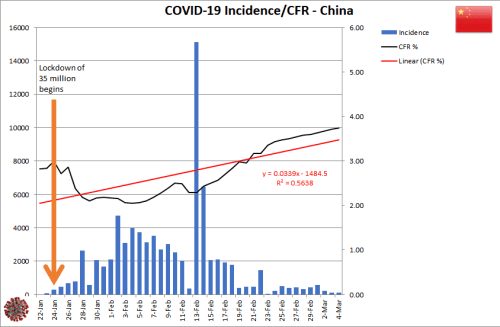
Assuming this data from China is accurate, which is a bit hard to determine, China’s measures to control the outbreak there have been successful. However, there is something to learn here.
There is something worth noticing in the CFR in China. Notice how that rate has continued climbing even though the number of new cases is falling. I simply have no guesses as to why that is happening.
That doesn’t bode well for the slow US response. It seems unlikely that the American public would ever accept those kinds of measures in any municipality if enacted, although based on how this is already impacting Seattle, people might self-select to stay home or be required by their employers to work from home.
The most alarming thing in that area is that eight of those deaths occurred at the Life Care Center nursing facility in Kirkland. Just yesterday I had written about the risks to the elderly and provided a graph of data from the China CDC showing the case fatality rates by age group. I only hope that skilled nursing facilities, assisted living facilities, and retirement communities are planning on how to protect their residents.
Let’s move to some of the global data. There’s something very interesting in it. Look at how the case fatality rate has settled at about 3.4% since February 25th. It’s unusual to see data for forming such a straight line. Most of this is from Iran, Italy, and China. South Korea remains an outlier with the CFR still hovering at about 0.5%.
Two days ago I predicted that things would start getting busy with this virus in the US in about 1.5 weeks. I may have overestimated. We will see if I’m right by the Ides of March.
The risk of death from COVID-19 increases with age and with comorbidities. The China CDC has published data on this which is very pertinent when it comes to planning efforts. I used this data to create the following graphs.
While children are at very low risk of death from COVID-19, there are many reports of schools closing. Academic models have been published about that approach with mixed results as to their effectiveness. In spite of that, it’s very clear that decisions are often not guided by research so we will likely need to be prepared for school closures that could extend for weeks, and maybe for the rest of the school year, which could affect staff availability for businesses, unless remote work is an option.
The bigger question though is since we have a reasonably good understanding of those at the highest risk of death, where should we be putting our intervention efforts? My opinion is that obviously hospitals and clinics are going to need to ramp up their preparedness activities, but there is an urgency to implement non-pharmaceutical interventions (NPIs).
It is going to be especially important to protect the elderly. Skilled nursing and assisted living facilities as well as retirement communities and other similar venues are going to need a great deal of education reinforcement on social distancing, respiratory hygiene, and hand hygiene. This also means that they may need to determine if there should be restrictions about visitors as well as trying to ensure that there aren’t problems with presenteeism with their staff.
We have a lot of work to do to be better prepared and an urgency to get these measures in place.
One of the benefits of actually looking at the data and not relying on the media is that questions start forming when patterns emerge without some of the biases that could be formed due to the bombardment of the sensationalism that can be found in media outlets, no matter their political leaning.
I had been puzzled by why there seemed to be difference case fatality rates in different countries.
Here’s the current data for South Korea. The CFR there is about 0.5%.
Compare that to Iran and Italy, where the CFRs are a little above 3%. The obvious question is “why the difference?”
I had a hunch based on my very early assumptions about mild and asymptomatic disease. That led me to wonder if the differences might have to do with testing. Once I did a media search, I found my answer.
I have suspected since early on that the CFR was artificially high. This is some solid evidence that assumption was right. Don’t let the tail wag the dog. This is how information from the media should be used.
If you are purchasing masks and gloves, you are endangering the lives of others who are or will be on the front lines. When coronavirus becomes active in your area, use the other methods that will help like social distancing, respiratory hygiene, and frequent handwashing/hand sanitizing.